SINGAPORE TRAVEL GUIDE
Singapore travel guide:
8 things to know before you go.
Best time to visit, entry rules, transport, where to stay, what to eat, what to see and the practical details. Written for first-time visitors who would rather not learn by mistake.
The one-line version: Singapore is safe, compact and easy to navigate; 3–5 days covers the core. With family or a tight schedule, a private car and guide makes the trip noticeably easier.
How should you plan a first trip to Singapore? Stay near Marina Bay, Chinatown or Orchard Road, and allow 3–5 days for Marina Bay, Chinatown/Singapore River, Sentosa and the Botanic Gardens. The city is compact and the MRT is excellent, but families and older travellers often prefer a private car.
GK Tour Guide editorial team · Last updated 2026-10-26
1. Best time to visit
Singapore sits close to the equator, so it is warm and humid all year, usually around 30°C in the daytime. February–April and July–September are relatively drier. November–January brings the northeast monsoon and more rain, though usually in short bursts rather than all-day downpours.
For outdoor plans, schedule Gardens by the Bay, the Botanic Gardens and Sentosa in the morning, and keep a museum, mall or hawker centre as a wet-weather backup. For a day-by-day shape, see our Singapore itineraries.
2. Entry rules
Many visitors, including Chinese ordinary passport holders, can currently enter Singapore visa-free for up to 30 days. Policies can change, so check the latest notice from Singapore's Immigration & Checkpoints Authority (ICA) for your nationality before booking.
Submit the SG Arrival Card online within three days of arrival, and keep your hotel address, flight number and return date on your phone for arrival checks.
3. Getting around
| Mode | Best for | Pros | Watch out |
|---|---|---|---|
| MRT | Solo travellers, couples, budget | Punctual, wide coverage, contactless payment | Crowded at peak; awkward with large luggage |
| Grab / taxi | Point-to-point, night, rain | Convenient, islandwide | Surge pricing and waits in rain/peak hours |
| Private car | Families, seniors, corporate, multi-stop days | Door-to-door, time-controlled | Arrange in advance; choose the right vehicle |
Changi Airport to the city takes about 30–45 minutes by MRT or 20–30 minutes by car, depending on traffic. With heavy bags, children or older parents, book an airport transfer. If you prefer door-to-door transport, see our Singapore private tours and chauffeur service.
4. Where to stay
- Marina Bay: first visit, skyline views, higher budget; walkable to the Merlion, Sands and Gardens by the Bay.
- Chinatown / Clarke Quay: food, nightlife and MRT convenience; good for travellers who like energy.
- Orchard Road: shopping, plenty of hotels, easy access to the Botanic Gardens and central areas.
- Bugis / Kampong Glam: characterful streets, good food, often better value.
- Sentosa: family resorts and beaches, but you add travel time to the city.
5. What to eat
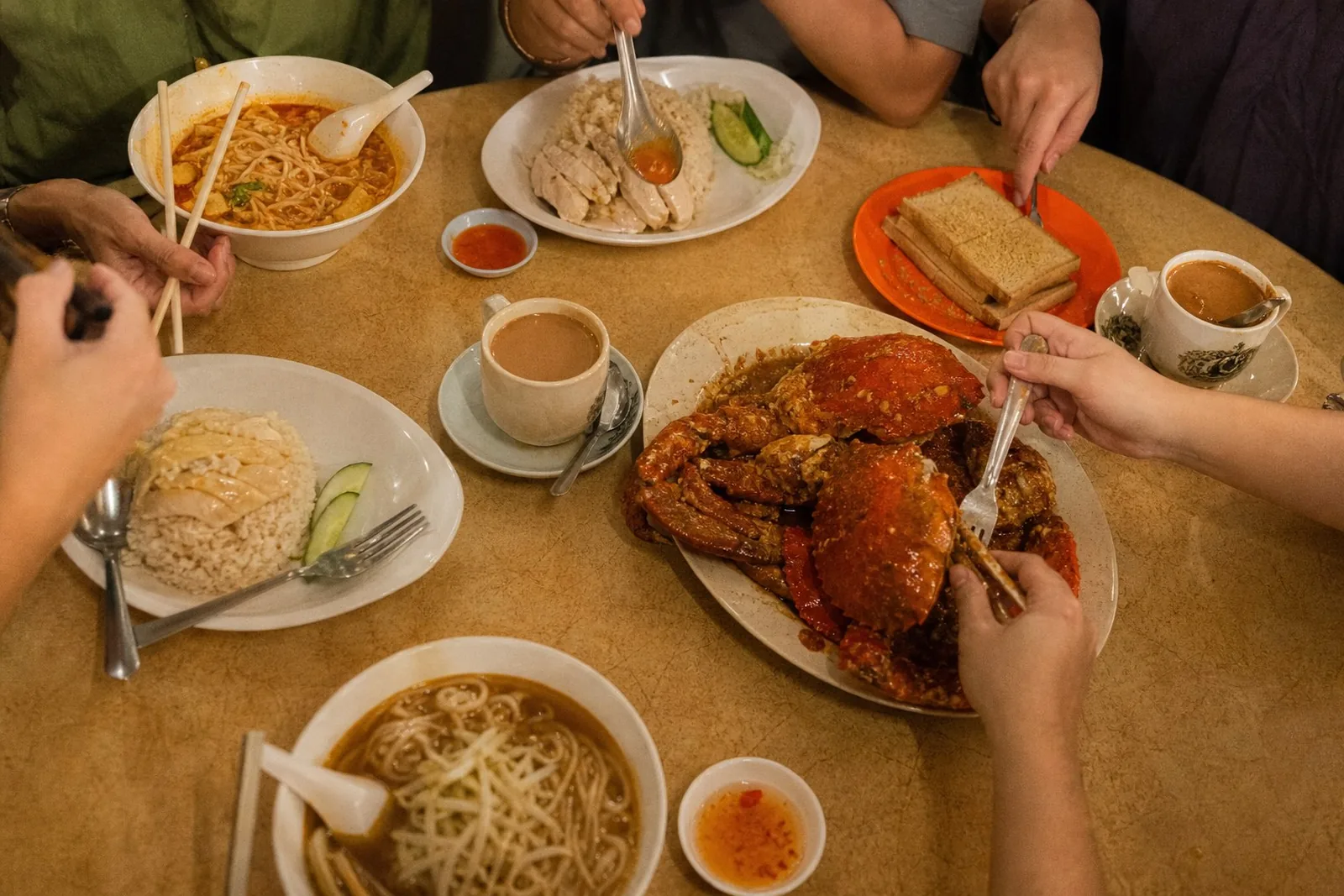
You do not need to chase “viral” restaurants. Hawker centres are often closer to everyday Singapore. First-timers should try:
- Hainanese chicken rice: tender chicken, fragrant rice — the safest first meal.
- Laksa: coconut curry broth, gently spicy and rich.
- Chilli crab: share it, and order mantou buns for the sauce.
- Bak kut teh: peppery pork rib soup with rice and dough sticks.
- Kaya toast, soft-boiled eggs and kopi: the classic Singapore breakfast.
Maxwell Food Centre in Chinatown, Lau Pa Sat, Katong laksa, Kampong Glam and Newton Food Centre are all reliable. With children, start with chicken rice and non-spicy noodles before branching out.
Singapore's hawker culture was inscribed on UNESCO's Representative List of the Intangible Cultural Heritage of Humanity in 2020. It is not just somewhere cheap to eat; it is part of the city's everyday life.
6. What to see
| Type | Recommended | Best for |
|---|---|---|
| City icons | Gardens by the Bay, Merlion Park, Sands SkyPark | First visit, photography |
| Family | Sentosa, Universal Studios, S.E.A. Aquarium, Zoo, River Wonders | Children |
| Neighbourhoods | Chinatown, Kampong Glam, Little India, Katong/Joo Chiat, Tiong Bahru | Walking, photography, food |
| Nature | Botanic Gardens, Gardens by the Bay, Southern Ridges | Green space, slower pace |
| Food | Maxwell Food Centre, Lau Pa Sat, Katong laksa, Newton Food Centre | Everyone |
The Singapore Botanic Gardens became the country's first UNESCO World Heritage Site in 2015. Visit early in the morning or late afternoon to avoid the midday heat.
7. What it costs
Your budget depends mainly on hotel class, attraction tickets, dining and transport. Hawker meals cost far less than restaurants; Universal Studios, the wildlife parks and Gardens by the Bay are the main ticket expenses. A private car and guide add cost, but shared across a family or group it often buys back time and energy.
On the destination side, Singapore's tourism receipts reached S$32.755 billion in 2025 (Singstat), with about 16.91 million international visitor arrivals. Mainland China was the largest source market. Popular attractions and holiday periods are busy, so advance booking and off-peak timing help.
Rather than optimising for the lowest total, decide which experiences matter most and put the budget there.
8. Practical etiquette
- Tipping: not expected; restaurant bills may include a service charge.
- Plugs: Type G, 230V; bring an adapter.
- Weather: carry an umbrella, sunscreen and water; indoor air-conditioning can be cold for children.
- MRT: no eating or drinking on trains; no smoking.
- Laws: littering, smoking and importing chewing gum are tightly regulated.
- Water: tap water is safe to drink.
The best way to see Singapore is not to tick off every attraction, but to leave half a day for a neighbourhood, a meal and an unplanned walk.
If you would rather not plan it yourself, see our Singapore tour guide service. Send your dates, group and who is travelling; we will turn the guide into a practical route.
FAQ
When is the best time to visit Singapore?
Singapore is a year-round destination. February–April and July–September are relatively drier; November–January brings more northeast monsoon rain. Carry an umbrella regardless of the month.
Do Chinese passport holders need a visa for Singapore?
Chinese ordinary passport holders can currently enter Singapore visa-free for up to 30 days. Rules can change — check the latest notice from Singapore's Immigration & Checkpoints Authority (ICA) before departure.
Do you tip in Singapore?
Usually not. Restaurant bills may already include a service charge. Tipping a guide or driver is optional and appreciated, never expected.
Is the MRT easy to use?
Yes. The MRT covers the main attractions and Changi Airport, and accepts contactless bank cards and mobile payments. With heavy luggage or older travellers, a private car is easier.
What plug type does Singapore use?
Type G, three rectangular pins, 230V. Bring a travel adapter for Chinese appliances; hotels can often lend one.
Is Singapore safe?
Singapore is generally very safe, but keep an eye on personal belongings and follow local rules — no eating or drinking on the MRT, no smoking in covered public areas, and strict rules on littering.
PLAN YOUR SINGAPORE TRIP
Read enough?
Let's turn it into an itinerary.
Send your dates, group and a few places you want to see; we will turn the guide into a practical route.